02 — HydraThermal Loop (HTL)

One water circuit.
Every case.
No machine room.

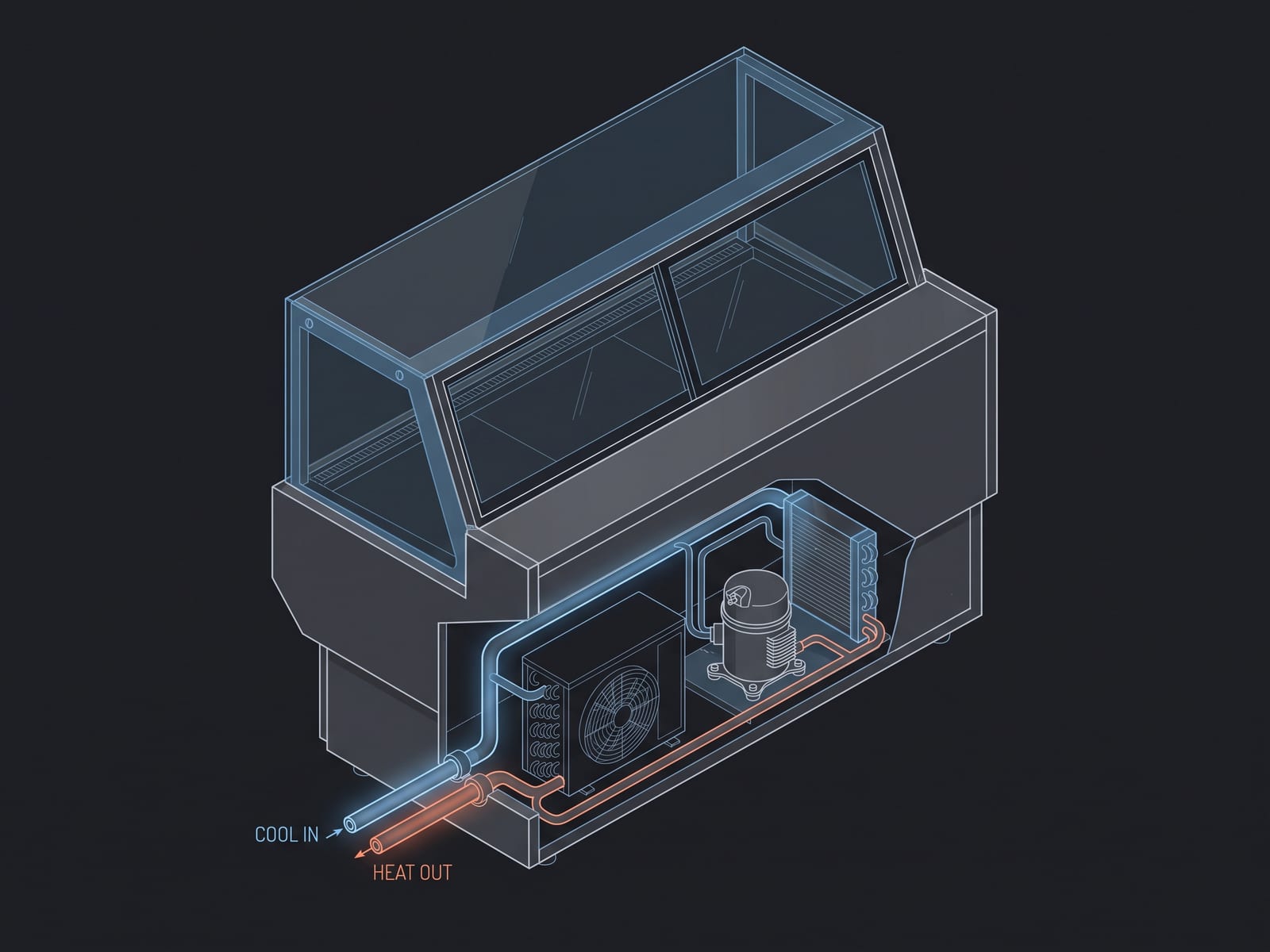
Traditional supermarket refrigeration is centralized: compressor racks in a machine room, hundreds of meters of field-welded copper line, and a single point of failure for the entire store. The HydraThermal Loop inverts that architecture. Each refrigeration unit carries its own small water-cooled condensing unit with a variable-speed compressor, and a simple water circuit carries the heat away — or puts it to work.

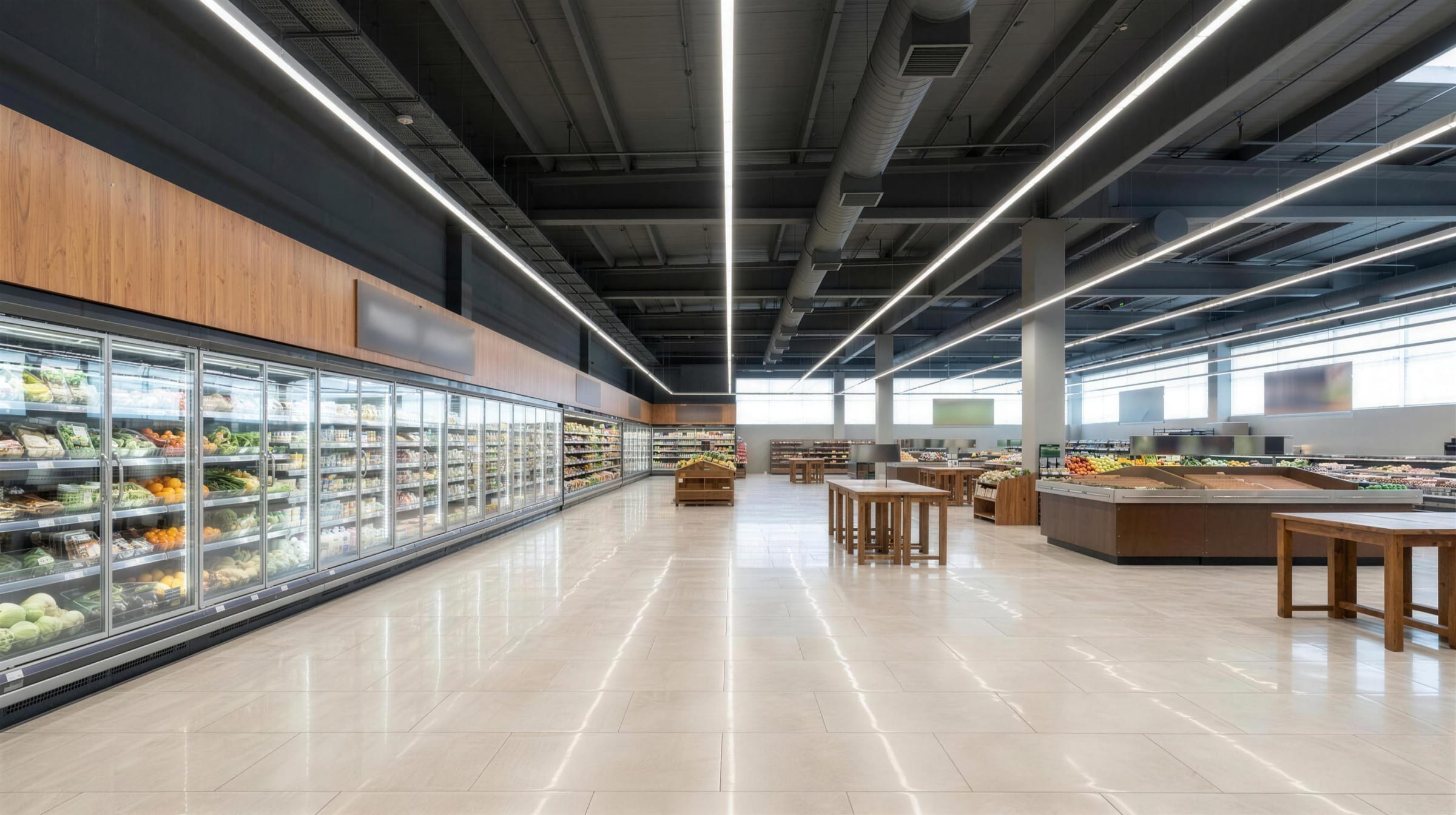
HydraThermal Loop waterloop refrigeration cases installed along a supermarket aisle, connected by a single water circuit

HTL.01

Distributed by design

Every case operates independently at its own optimal conditions. Plug-in architecture lets each unit's controller run in favorable conditions, and modulating compressor speed to actual load maximizes COP.

Under the hood, each case runs a DC inverter compressor that modulates continuously between roughly 30 and 100% of capacity, instead of the all-or-nothing cycling of fixed-speed machines. And because there is no shared suction group, no case is dragged down to the lowest common evaporating temperature: chilled dairy and frozen food each hold their own setpoint at the highest — and therefore most efficient — pressure their load allows.
HTL.02

Engineered savings

Permanent-magnet DC compressors, variable-speed operation, and independent optimization compound into measurably lower energy consumption — with maintenance cost savings of up to 30% from factory standardization.

The biggest single lever is the condenser itself. A compact brazed-plate heat exchanger fed by the water loop replaces the air-cooled fin-tube coil, holding condensing temperature near the loop's 25–35 °C all year instead of chasing summer rooftop air at 45 °C and above. Lower condensing pressure means a lower compression ratio — and every degree of condensing temperature saved returns roughly 2–3% of compressor energy.

HTL.03

Near-zero leakage

Units arrive factory-charged and sealed. Total refrigerant charge drops by around 80%, and annual leak rates fall by roughly 96%. Natural R290 refrigerant (GWP 3) makes the system future-proof against refrigerant regulation.

Each circuit is factory-brazed, hermetic, and holds only about 150 g of R290 — comfortably inside the charge limits for A3 refrigerants in occupied spaces — versus the hundreds of kilograms circulating in a field-piped remote system. With no field-made joints on the refrigerant side, the leak paths that plague copper line sets simply do not exist: what is sealed on the test bench stays sealed in the store.

HTL.04

Days, not weeks

Pre-charged, line-tested units cut commissioning to a couple of days even for stores with 100+ showcases. RIMASEE installs at no cost — the single largest line-item advantage over a remote rack system.

The speed comes from what disappears off the critical path: there is no refrigerant piping to route, braze, pressure-test and evacuate on site. The water loop is ordinary insulated pipe that any competent plumbing contractor can install while the store keeps trading, and cases arrive run-tested from the factory — roll them in, connect water and power, and they pull down to temperature the same day.

HTL.05

Heat that pays you back

Condensation heat can be recovered to heat the store or its water supply, turning a waste stream into an asset on your utility bill.

In engineering terms the loop is an ideal low-grade heat source: a steady 30–35 °C return is exactly what plate heat exchangers and water-to-water heat pumps want to see. In winter the pump station simply diverts flow through the recovery exchanger ahead of the drycooler, so heat that would be rejected to the sky offsets the store's space heating and sanitary hot water instead.

HTL.06

The integral solution

HTL is electrically simple: plug-in loads on a water circuit. That makes it the natural backbone for on-site solar and battery storage integration — refrigeration, heating, and energy generation as one engineered system. This is where RIMASEE goes beyond the equipment: we design the whole loop.

In practice the loop becomes the building's thermal bus. Drycooler capacity, the solar array and battery storage are sized as one balance-of-plant calculation, and a single controls layer supervises compressor speeds, pump flow and heat-recovery valves. One engineering package, one commissioning, one point of accountability — instead of three vendors meeting for the first time on your rooftop.

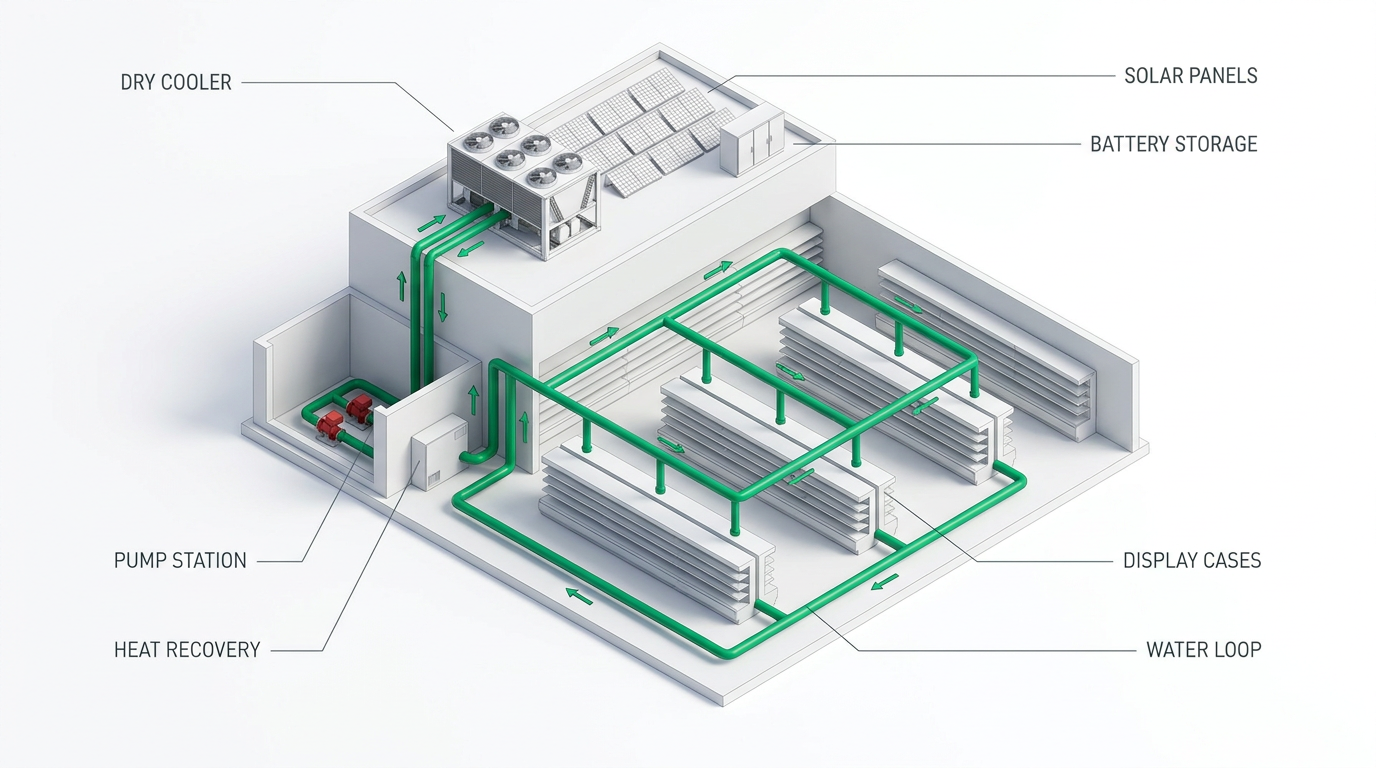
Isometric overview of a full HydraThermal Loop store: display cases connected by a single green water loop to a pump station, heat recovery, rooftop drycooler, solar array and battery storage
System overview — the complete HydraThermal Loop: every case on one water circuit, from the sales floor to the rooftop drycooler, with heat recovery, solar and battery storage.
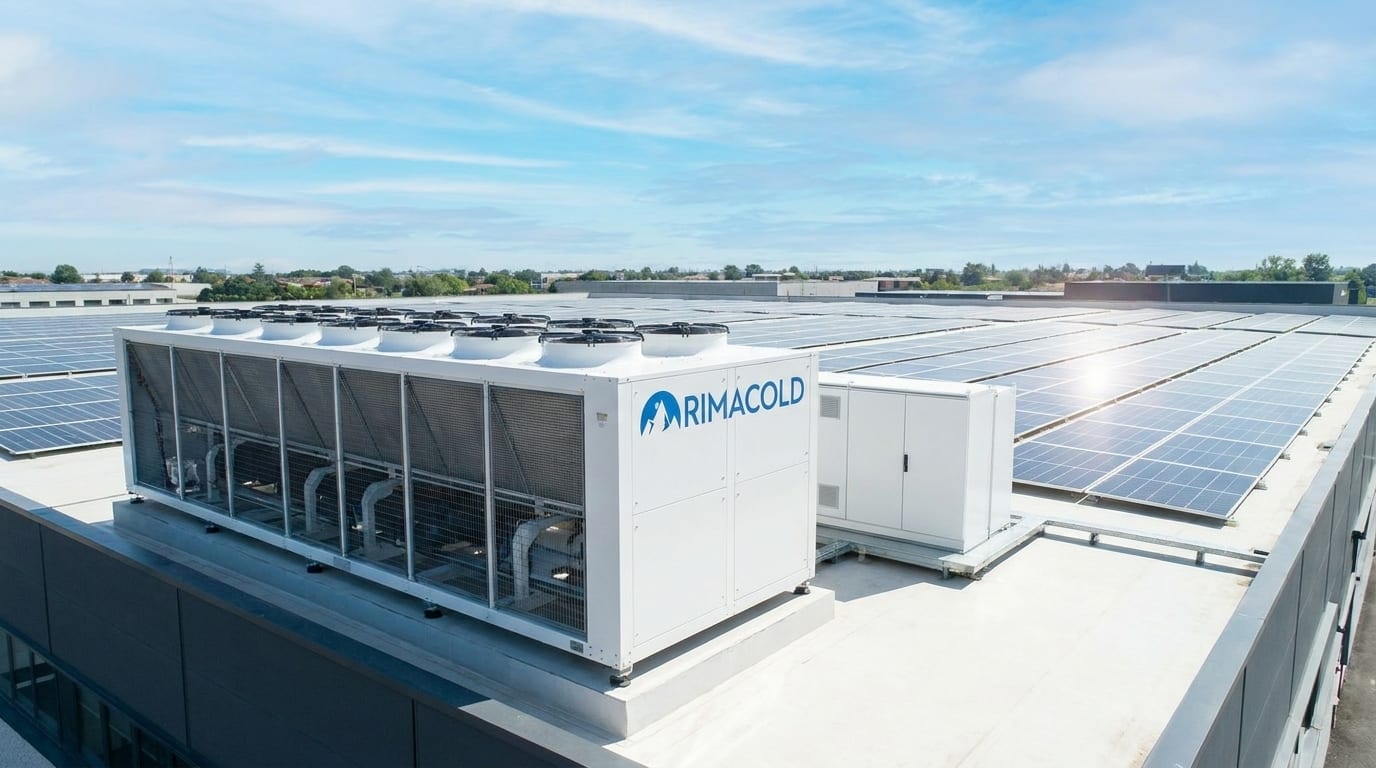
RimaCold rooftop drycooler rejecting heat from the HydraThermal Loop water circuit, surrounded by a rooftop solar array
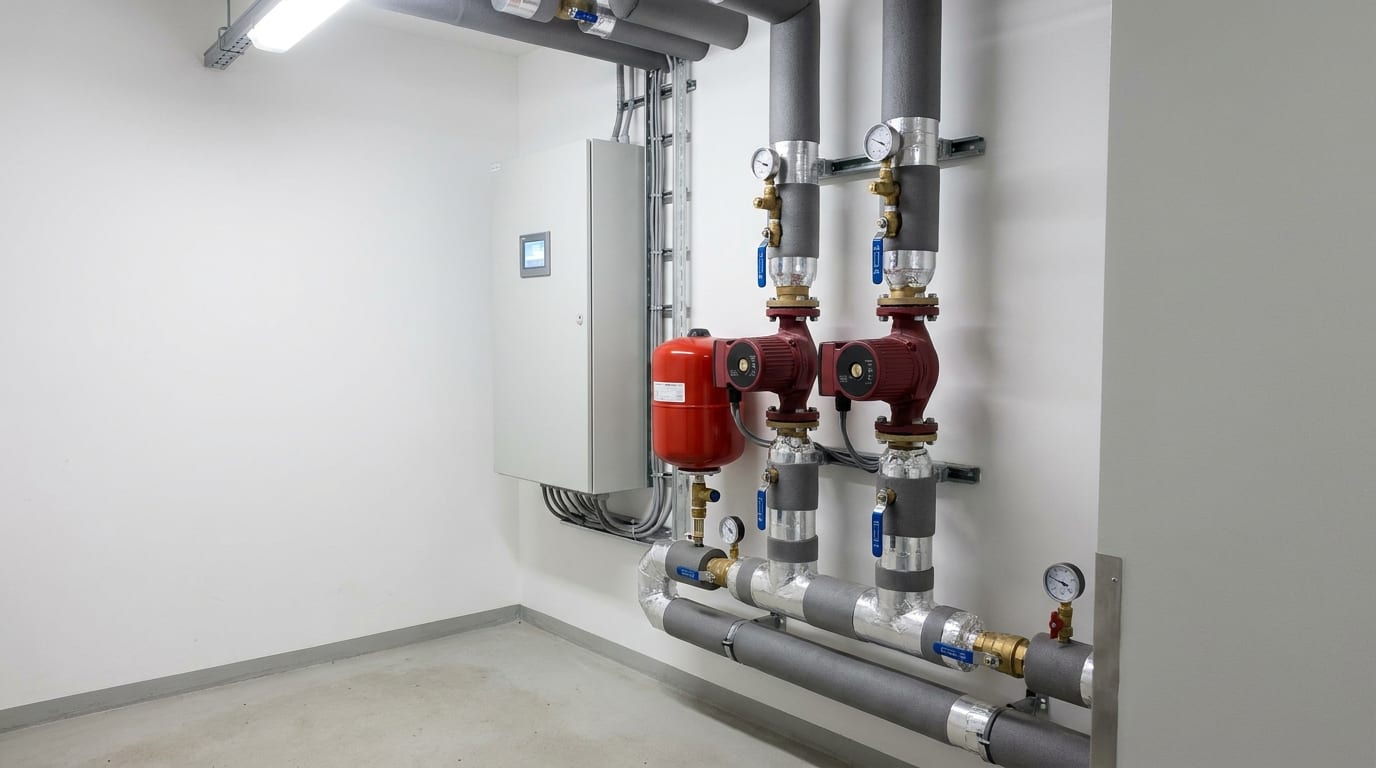
HTL pump station with twin circulation pumps, expansion vessel and insulated water-loop piping

How the loop works

HydraThermal Loop system schematic: self-contained display cases branched to a single overhead water loop, through a pump station with twin circulation pumps and an expansion vessel, to a rooftop drycooler — with heat recovery and on-site solar and battery storage. Solar array Battery storage Rooftop drycooler Self-contained display cases Overhead water loop Pump station 2× circulation pumps · expansion vessel Heat recovery Store heating Hot water Water circuit Recovered heat Electrical
HydraThermal Loop system schematic: self-contained display cases branched to a single overhead water loop, through a pump station with twin circulation pumps and an expansion vessel, to a rooftop drycooler — with heat recovery and on-site solar and battery storage.

Compatible Models

RIMASEE retrofits RimaCold's full equipment range onto the HydraThermal Loop system for projects that require it.

The models below are representative examples, not a fixed list — any case in the current RimaCold catalogue can be engineered onto the loop. Specifications are drawn from RimaCold's published datasheets; fields the manufacturer hasn't published are marked accordingly.

Isometric cutaway of a single self-contained display case showing its integrated water-cooled condensing unit, with cool water entering and recovered heat carried out
Loop detail — inside one self-contained case: the water-cooled condensing unit and plate heat exchanger that replace the traditional air-cooled fin-tube design.

RimaCold

Florida OV

Low-profile, plug-in open multideck for dairy, deli, produce and drinks — RIMASEE's best-selling open-front merchandiser, retrofitted with a water-cooled condensing unit in the base.

Dimensions (L × D × H)
937–3750 mm (modular) × 886 mm × 2050/2160 mm
Refrigerant charge
R290, 0.14–0.15 kg per circuit (longest units run 2 circuits)
Temperature class
−1°C to +5°C (Product Class M1)
Capacity / display volume
Display area 2.9–9.0 m² (by length)
Compressor type
Plug-in, self-contained (compressor model not published)

RimaCold

Eskimo

Curved-glass serve-over counter for meat, deli, cheese and fish — modular linear and corner units, adapted with a water-cooled condensing unit in the base.

Dimensions (L × D × H)
36⅞″–147⅝″ × 42⅜″ × 49⅝″
Refrigerant charge
R290, 0.125–0.15 kg per circuit (longest units run 2 circuits)
Temperature class
−1°C / +5°C (30–41°F), Product Class M1
Capacity / display volume
Display area 8.61–34.34 ft²
Compressor type
Plug-in (self-contained) as standard; remote system also available

RimaCold

Bronx C 3HX

High-capacity six-deck remote meat merchandiser for the busiest departments — the loop replaces its remote compressor rack with a water-cooled connection.

Dimensions (L × D × H)
3′ 7⅛″–12′ 3⅝″ × 43⅛″ × 85¹⁄₁₆″
Refrigerant charge
R404a standard; R290 by special order (charge not published)
Temperature class
30–41°F (Class 3H)
Capacity / display volume
Display area 42.3–126.7 ft²; refrigerated volume 32.6–95.4 ft³
Compressor type
Remote (compressor not integral to the case)

RimaCold

Liberty Island SM

Wide-footprint frozen-food island with deep glazing for high-volume display — the loop's alternative to a remote frozen rack.

Dimensions (L × D × H)
W 62⅜″–63⁷⁄₁₆″ × H 36⅝″–43⅛″ (length modular, not published)
Refrigerant charge
R404a standard; R290 by special order (charge not published)
Temperature class
[confirm with datasheet]
Capacity / display volume
[confirm with datasheet]
Compressor type
Remote, multiplexable linear & corner modules

HTL Savings Calculator

Estimate what the HydraThermal Loop saves in your store. Adjust to your site.

40
0.14
18
Energy saved / year49,823 kWh
Savings / year$6,975
10-year cumulative$69,752
Refrigerant charge−80%
CO₂e avoided / year18.5 t

Estimates based on industry-documented waterloop performance data. Site-specific audit available.

The system in numbers

−80%

refrigerant charge

−96%

annual leakage

−30%

maintenance cost, up to

~2 days

commissioning

GWP 3

R290 refrigerant

None

machine room

Ready to close the loop?

Request a site audit